Designing an instrument and underground infrastructure like the Einstein Telescope is a process of many stages and refinements. Physicists want the best instrumentation to do the most advanced science, but it also has to fit into a realistic underground structure and take risks and costs into account. In order to keep these factors in balance, a multidisciplinary taskforce worked on an integrated baseline design between January and June 2025. The new integrated baseline design is not the final design, but an important step in preparing for implementation.
The taskforce was led by the Einstein Telescope Organisation (ETO), and consisted of 49 scientists and engineers from 17 organisations in 8 countries. The scientists involved are also active members of the Einstein Telescope Collaboration. The experts specialise in different fields: optics, seismic isolation, vacuum and cryogenics, engineering, civil, technical and systems engineering and risk management. Liaisons for the candidate sites Sardinia and the Euregio Meuse-Rhine were actively involved.
Andreas Freise, director of the Einstein Telescope Organisation, explains why the work was organised in this way: “More than a thousand people are part of the Einstein Telescope today. We set up this taskforce to create a space for a smaller group with a clear goal. Their assignment was to complete the so-called baseline design of the instrument at the heart of the Einstein Telescope. This is a key milestone for the project. With ETO we are building the environment and management structures that are necessary for very large project teams to work well together. Long term stability is important for the project. But when needed, we can sidestep the normal work and create something special. And that is what we did here.”
Fiodor Sorrentino is Technical Coordinator at the Einstein Telescope Organisation and coordinated the process: “We started on the 25th of January and had an aggressive schedule with weekly online plenary meetings, aperiodic expert meetings and three in person workshops, one in Pisa, one in Amsterdam and one at CERN. We started with the reference design of 2024 and looked at the triangular as well as the L-shaped optical layout. Along our work we went through different steps: from identifying constraints and the most critical parameters for civil engineering and costing, to defining optical configurations, generating detector layouts and performing cost evaluations and risk analyses. And of course we asked external experts to review our work before making it final.”
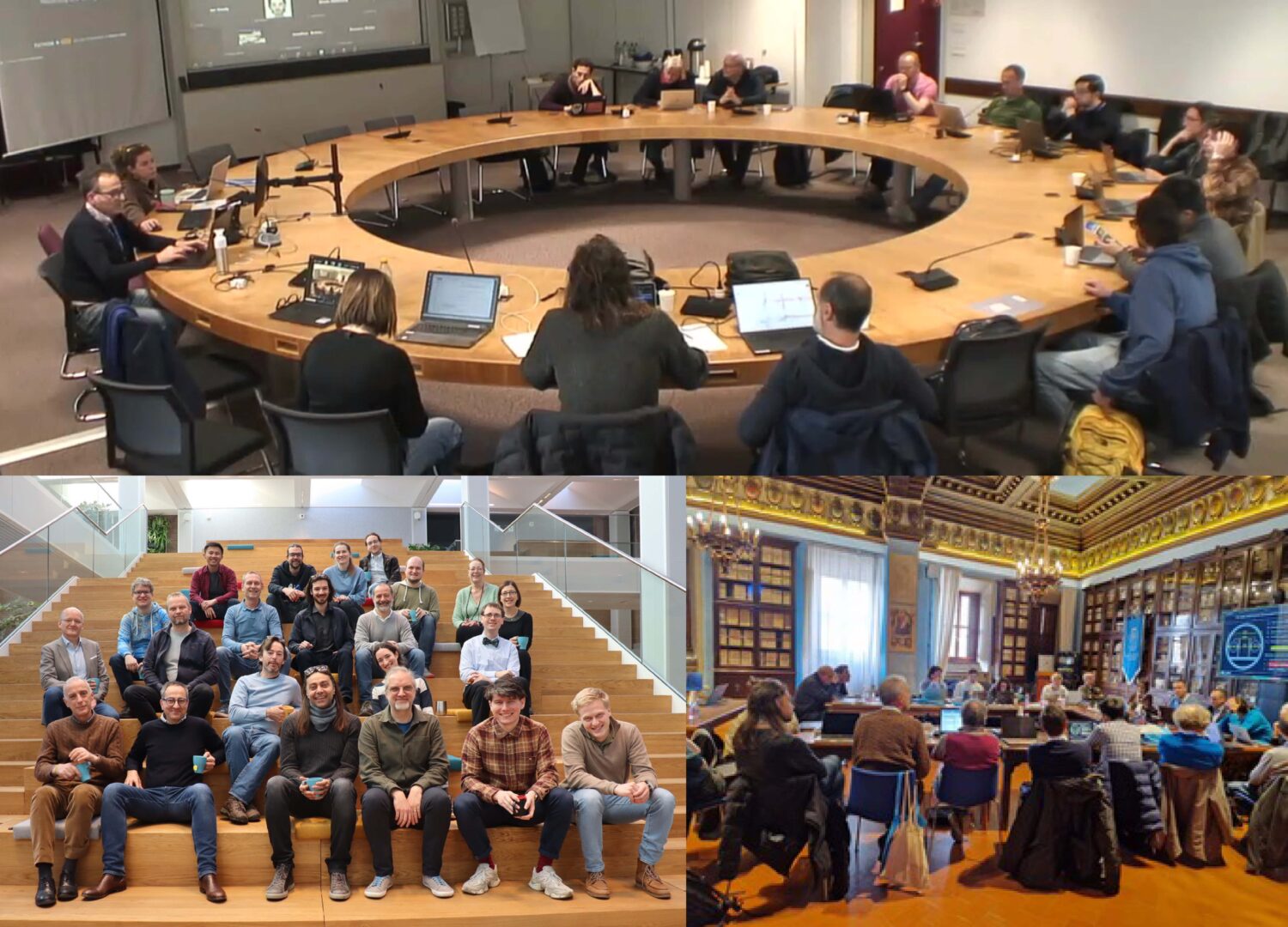 Impressions of taskforce meetings at CERN, in Amsterdam and in Pisa.
One of the core members of the taskforce is optics expert Anna Green. She focused on the positions and curvatures of all of the major optical elements (laser, mirrors, etc) and subsystems within the detector. Together with colleagues, she coordinated this optical layout and the liaising and integration with other expertise.
“It was an intense and productive period,” Green explains. “We quickly understood that no design element can be treated in isolation, as it impacts the others. For example: the size of the cryogenic systems and the structural stability of the excavated caverns constrain the optical design. In turn, the optical design imposes requirements on the suspension and vacuum systems. It was therefore immensely valuable to sit in the same room with representatives from every expertise. This enabled us to understand the various challenges and trade-offs and to negotiate a way forward. I learned a lot from these colleagues. And I hope we can continue this more integrated approach in the longer term.”
Sorrentino also values the collaborative attitude. “49 scientists and engineers from different organisations were involved in this work, and I was very happy about the constructive discussions. In such a large project, there are bounds to different interests and opinions, which could lead to a negative atmosphere. But instead, we had productive discussions and everyone participated constructively and understood the task. I feel we came up with very good solutions that really improve the feasibility and affordability of the design.”
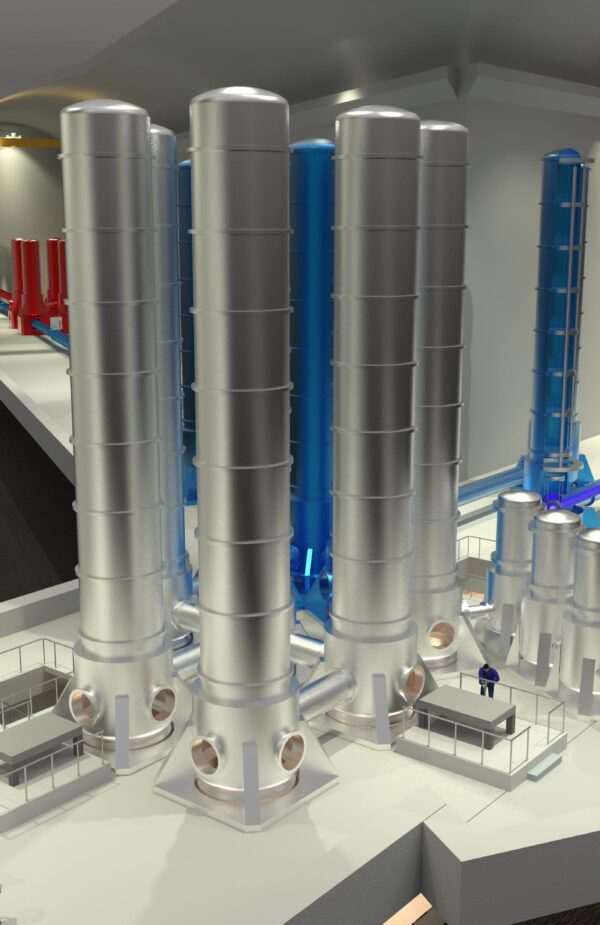
One of the main implementation challenges and the biggest cost of the Einstein Telescope, will be the underground caverns and tunnels that will host the gravitational wave detector. Therefore reducing the underground volume was one of the topics on the table of the taskforce. They studied multiple options. For example, they examined whether filter cavities could be moved into the main tunnels instead of being in a parallel one. And they investigated how the height of the instrument carrying towers could be reduced. All without posing safety risks. In the end, the group managed to reduce the planned volume of the 2L-detector layout by 27%, and the planned volume of the triangle by 26%.
Another topic under evaluation was how to keep a level of flexibility that is necessary at the current stage of the project. In this huge enterprise, it could be that some parts will have to shift based on the final construction. Green clarifies why it is important to keep some flexibility in for example the optical layout: “We envisage the Einstein Telescope as a facility that will last many decades. Current detectors have benefited from frequent interventions to commission upgrades or install new technologies to boost observing range and improve reliability. We anticipate the same will be true for ET. Being underground means the volume available for these changes is very constrained. We compiled an initial list of places where additional volume is most likely to be beneficial (from an optical layout perspective). The engineers then considered this list in terms of broader feasibility. This also allows space for adjustments as the many finer details of the baseline design, which will also impact the overall layout, continue to be calculated.”
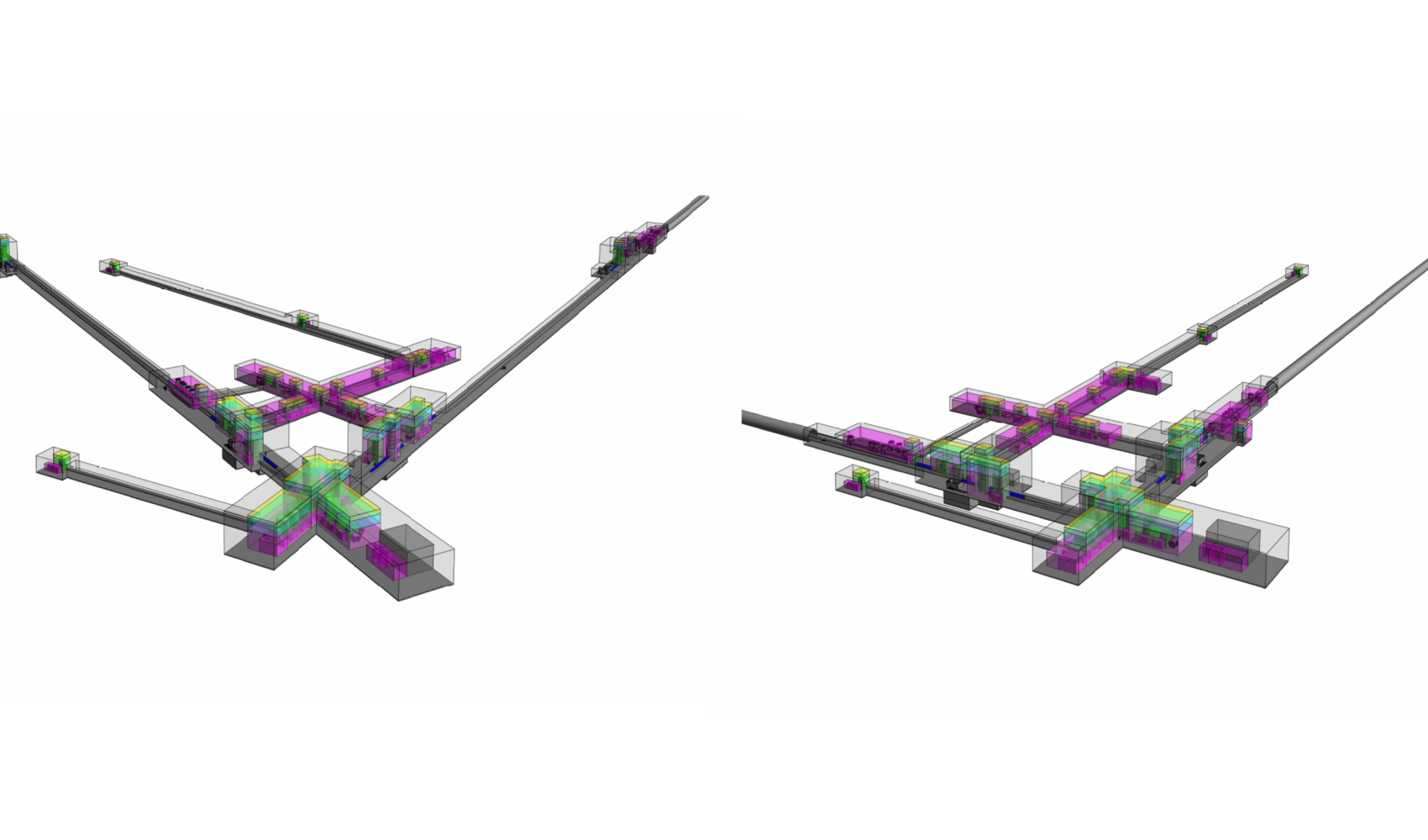
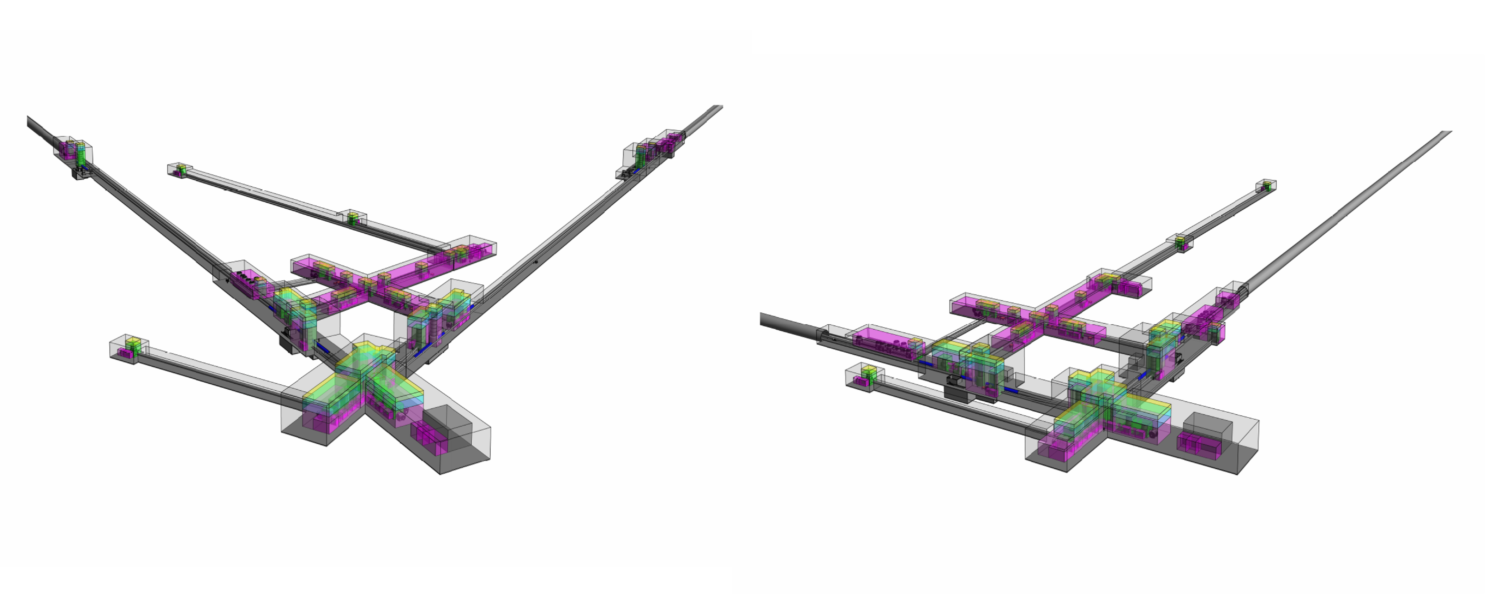 Visualisations of the corners of the new baseline designs for the triangle and the L-shaped geometry.
Changing designs of an instrument could potentially change the science that can be done with it. Of course it is important to keep this impact as small as possible, and ensure that the scientific goals can still be reached. Mikhail Korobko was one of the taskforce members who focused on this, bridging the instrumentation and the observational science.
“Our goal was to make sure the science case did not suffer from any changes to the detector design,” Korobko points out. “For each design modification, we evaluated its effect on detector sensitivity, which is set by various noise sources and ultimately limits the science we can do with the Einstein Telescope. Even a small change to the noise budget might affect the science case, sometimes quite dramatically. Importantly, the impact depends on the frequency range. For example, some changes would impact the ability to detect stochastic gravitational-wave background, while the others could affect parameter estimation for binary systems. We worked as a team of instrumental and observational science experts. Together we realised a toolbox that allowed to connect sensitivity and the science case and compare the influences of various changes. This work allowed us to maintain the original science goals. Moreover, it also gave insight into the parameters of the instrument with the highest impact on the science case.”
In June the group finalized their results: a pile of documents describing a new baseline design for the detector, including reduced volume and tower height, better definition of the technical infrastructure, an interface with civil engineering and risk and flexibility analyses on design choices.
This new baseline design marks an important step, and will be followed by other more refined designs in the future, says Freise: “The new baseline design marks the starting point of a more formal engineering-led process. The design of the Einstein Telescope is an iterative process and will continue until we install and switch on the instrument. We are now bringing together very different challenges and solutions: on the one hand we want to design a laser interferometer which can best measure a gravitational wave and on the other hand we want to find a cost-effective way to excavate a safe and quiet underground facility. In the design process we must combine all these requirements and, over time, fine tune and optimise the technical solutions and blueprints. I am excited about leading this process, in which multi-disciplinary teams with physicists from the scientific collaboration work closely together with project engineers and experts from the teams preparing the underground sites.”