
The Einstein Telescope
The Einstein Telescope is poised to revolutionise our comprehension of the Universe and the fundamentals of gravity, while pushing the boundaries of technology. The instrument is designed as a third-generation underground facility. This means it builds on the successes of second-generation laser-interferometric detectors such as Advanced Virgo, Advanced LIGO and KAGRA. The ambitious European project is driven by an international collaboration, uniting scientists and resources from around the globe to achieve pioneering discoveries.
The Einstein Telescope will explore the Universe through gravitational waves, providing a unique window into cosmic history up to the dark ages, when stars and galaxies have not yet formed. It aims to unravel mysteries of fundamental physics, astrophysics, and cosmology, including studying neutron stars in unprecedented detail, understanding black hole horizons, shedding light on dark matter’s nature, the potential modifications of general relativity at cosmological scales, the Universe’s early days and its future evolution.
The Einstein Telescope is set to achieve an unprecedented level of sensitivity by employing various cutting-edge technologies. This includes increasing the interferometer size, implementing a cryogenic system to cool optics, using new quantum technologies to reduce light fluctuations, and employing active noise-mitigation measures to minimise environmental disturbances. Additionally, the underground facility will isolate the detector from vibrations caused by seismic waves and human activities. This enables precise measurements of gravitational waves in a silent environment.
After the successful inclusion in the ESFRI Roadmap 2021, the Einstein Telescope project has entered its preparatory phase, with plans to construct it in the next decade and start observations by the early 40s. Three candidate sites are currently under evaluation: these are located in Sardinia in Italy, in the Euregio Meuse-Rhine cross-border region spanning parts of Belgium, the Netherlands, and Germany, and in Lusatia in Germany. The governments of countries actively supporting the Einstein Telescope have planned a process towards a location decision, currently foreseen in 2027.
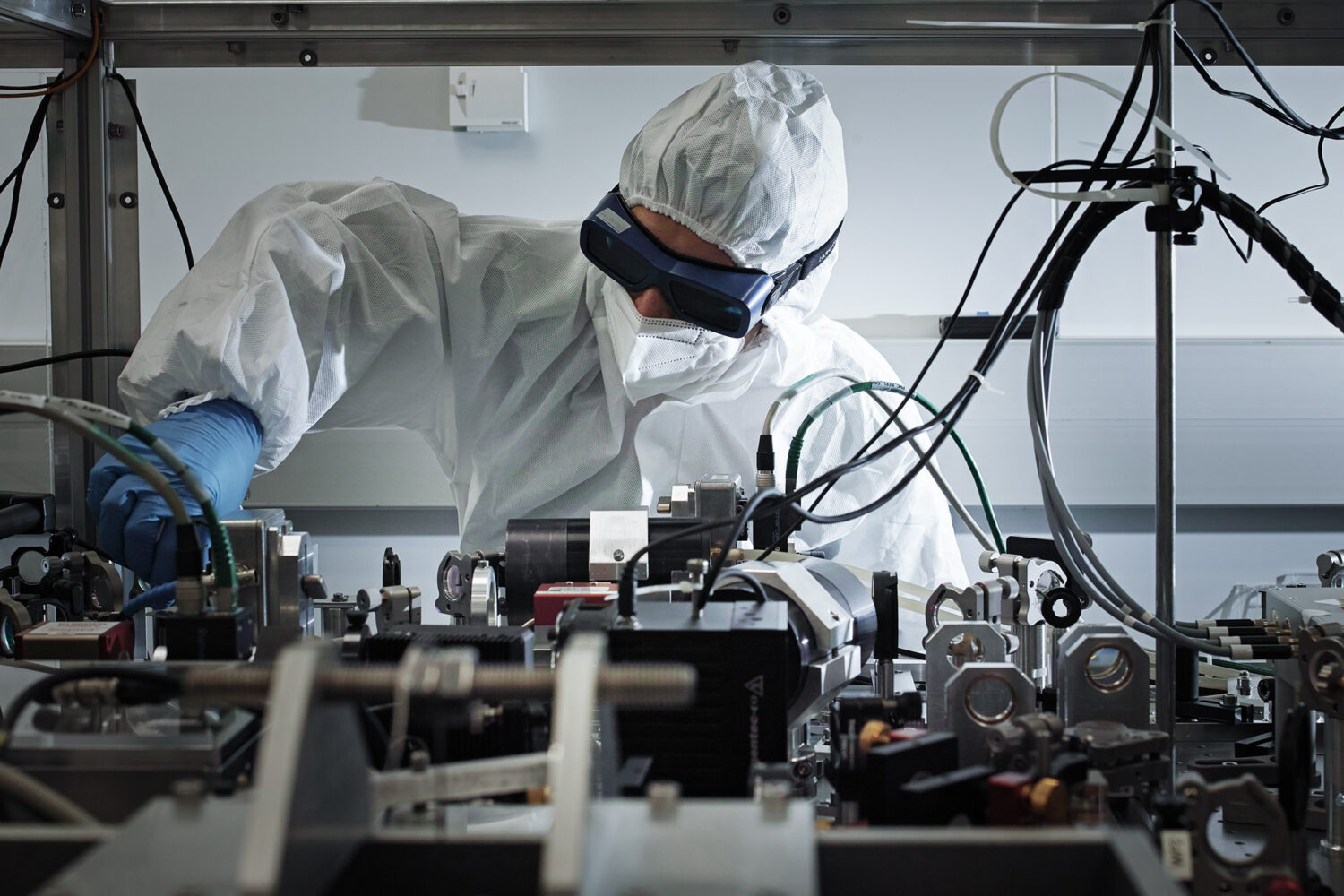 One of the researchers of the Virgo gravitational wave detector working on an optical bench. Credits: Marco Pinarelli
The construction and operation of the Einstein Telescope are expected to bring a significant economic boost to many European countries. For instance, by creating jobs in engineering, manufacturing, and other industrial sectors; by attracting funding, investments, and collaborations in research and development; and by fostering partnerships between academia, industry, and government agencies.
Technological innovations generated by the Einstein Telescope have the potential to bring far-reaching impacts, contributing to practical applications in various industries, from healthcare to telecommunications.
This effort will be accompanied by a significant educational and outreach program, aimed at engaging the general public and in particular the next generations in gravitational wave science, physics, and astronomy. These programs will be carried out with the broader goal of increasing general awareness of the crucial role of fundamental research in a global world from cultural, economic, and societal perspectives.