After signing off on the documents, project manager Alessandro Variola of the Einstein Telescope Organisation was relieved: “I’m glad we’ve released the document, thanks to the dedication and hard work of the entire GCR team. The timing and circumstances were extremely challenging, but the quality of the final deliverable is absolutely satisfying. With an additional phase of coordinated work, we could achieve even better results. However, the fact that we brought the community together, had the opportunity to gather information from so many internal and external experts, and were able to organise all the information we received, is certainly a major step for the Einstein Telescope.”
The input for the document came from across the Einstein Telescope community, including the scientific Einstein Telescope Collaboration, the candidate host consortia and external organisations including CERN, ESA, ESO, LVK, CTAO, ESS, SKAO and the ERIC Forum. The Einstein Telescope Organisation (ETO) provided the framework and coordination to bring this together.
ETO Directors Andreas Freise and Fernando Ferroni are pleased with the delivered work. Andreas Freise says “This is exactly the kind of work ETO was established for. With a large community of experts and ETO’s structured framework and central coordination, we are turning the Einstein Telescope into a feasible project. This report shows how we do that in a broad European framework.” Fernando Ferroni adds “This work has been a cornerstone in fulfilling the ETO mission. We will continue to do this, to bring these management structures and frameworks to move the Einstein Telescope forward.”
Michele Maggiore, Spokesperson of the Einstein Telescope Collaboration, also values the collaborative effort. “We congratulate all people who, with intense and dedicated work, have contributed to the Geometry Comparison Report. The GCR provides an authoritative source of information for the geometry decision. Members of the ET Collaboration have significantly contributed to all work packages, and in particular managed the work on Scientific Added Value. The results of that work package confirm and expand the previous studies of the Collaboration. We also express our appreciation for the fruitful interaction between the ET Collaboration and ETO.”
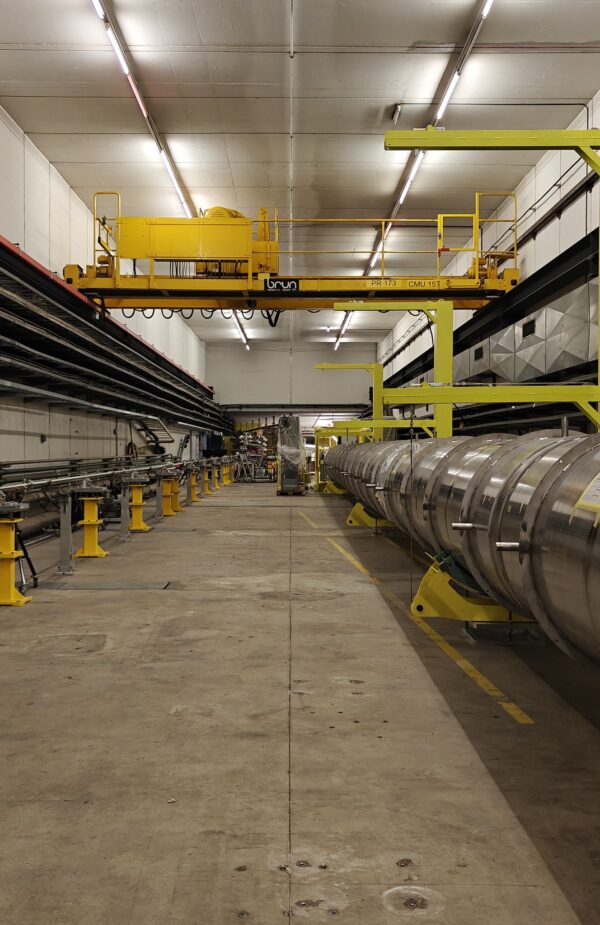
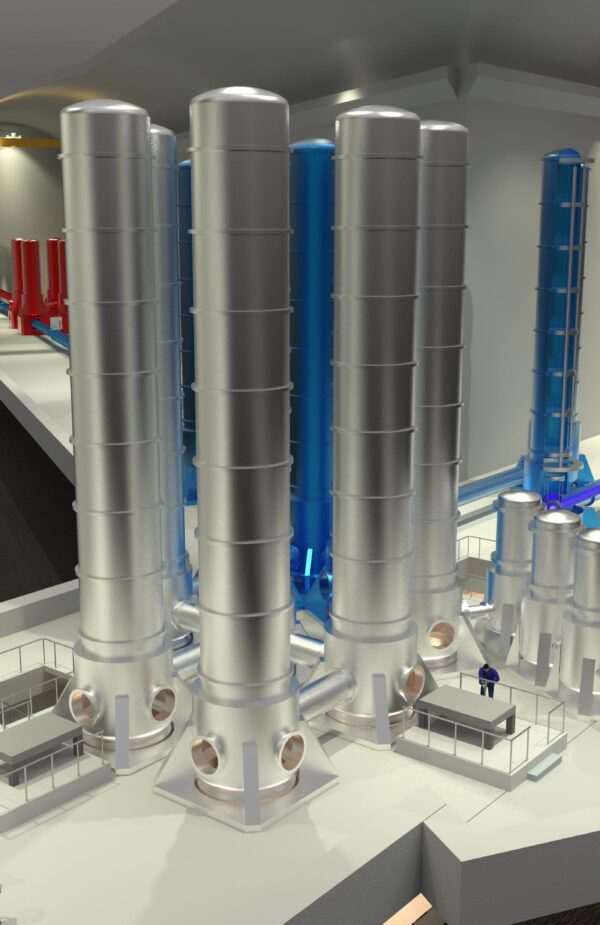
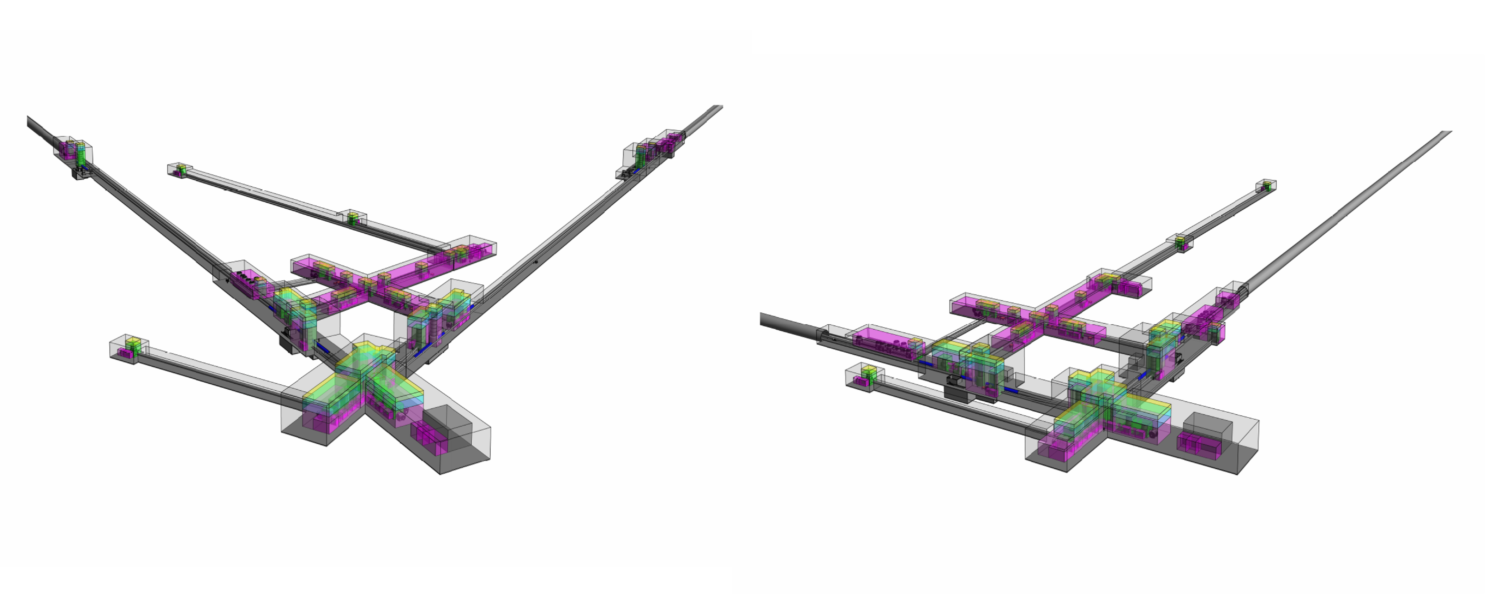 Visualisations of the corners of the baseline designs for the triangle and the L-shaped geometry.
The Geometry Comparison Report is set up as a site-independent overarching report that outlines the pros and cons of different potential geometrical configurations for the Einstein Telescope. The options currently under consideration are: a triangle with three sides of 10 km, and two separate L’s with arms of 15 km located about 1200 km apart and at set angles from each other.
The work was divided into five domains: the scientific added value, risk, costing, governance and socio-economic impact. Each topic was dealt with by a dedicated group and, depending on the topic, involved different internal and external experts. Several of the work packages draw a more direct comparison between the two geometries. For other domains the comparison is less direct, because of data maturity, boundary conditions and site-independence requirements. The report also offers a snapshot of where the Einstein Telescope stands today across the included domains.
Alessandra Buonanno, Director at the Max Planck Institute for Gravitational Physics and a leading figure in the worldwide gravitational wave community, chaired the group that assessed the scientific added value. She describes how they worked: “The Einstein Telescope (ET) will trace black holes across cosmic time, probe matter denser than any lab can create, pair gravitational waves with light, and glimpse the early Universe. As chair of the Scientific Added Value chapter, I had the privilege of assembling and leading a team of thirteen scientists from Europe and the United States. We distilled these goals into a set of ‘golden channels’, key science cases that we used to test each proposed geometry. On a tight timeline, we worked to give a fair and coherent comparison of the configurations. Our conclusion: every design delivers outstanding science; the choice decides which measurements ET will do best. It was intense, inspiring work, and the decision it informs will shape European science for decades.”
The group that focused on costing looked at five cost categories: the detector, arm vacuum, computing, interface systems and life cycle. Alessandro Variola explains: “Once we broke the project down into its various systems, we applied different cost estimation methodologies depending on each system’s level of maturity. This is natural during the early stages of a project’s life cycle, and it will be necessary to refine the estimates as the detector design advances. Thanks to a collective effort by the Einstein Telescope Organisation and the Einstein Telescope Collaboration, we gathered the necessary information for each element in the detector. The candidate host consortia are responsible for delivering the cost of the technical and civil infrastructure at a later stage. These numbers are not included in this study. But during our work we jointly studied the costing methodologies the candidate host consortia can use to deliver their figures.”
The groups focusing on risk analysis, governance and socio-economic impact involved in total 120 internal and external experts through interviews, questionnaires and by asking them to fill in various forms of registries and analyses. One of the external experts who provided input for the governance aspects was Simon Berry. As Deputy Director General of the SKA Observatory, he still has similar processes fresh in mind: “The steps to establish large Research Infrastructures such as ET are complex and multi-dimensional, combining scientific, technical, financial and political issues. We tackled many such points and challenges in the earlier days of the SKAO and it’s a pleasure to now be able to offer our advice and experience to the ET project and help make it a success.”
CERN Director for Stakeholder Relations Ursula Bassler feels that bringing this information together is an important step for the Einstein Telescope. “Establishing an international research infrastructure is a complex undertaking that requires balancing the interests of many stakeholders and putting in place governance capable of supporting the project through its most challenging moments. CERN’s experience shows how essential these foundations are for long-term success. My best wishes to the Einstein Telescope as it strives to become another inspiring example of European scientific collaboration.”
The decision on the geometry of the Einstein Telescope will have a significant impact on the project, gravitational wave science, and the countries involved. It requires thorough information that takes the complexity and multifaceted nature of the case into account. This report is a compilation and assessment of that information. It does already point to the following insights:
More details can be found in the publicly available Geometry Comparison Report Executive Summary (pdf).
The report will now be studied by the Board of Governmental Representatives. It is a knowledge resource that will support informed decision making.
Einstein Telescope coordinators Antonio Zoccoli and Jorgen D’Hondt explain what to expect. Antonio Zoccoli says “The Geometry Comparison Report is a major milestone for the Einstein Telescope project. It provides the Board of Governmental Representatives, governments and the scientific community with the essential evidence to make an informed decision on the observatory’s geometry. For the first time, we have a robust, comprehensive and shared comparative framework, clearly indicating the way forward. I thank all experts for their rigour, strong commitment and collaboration, and ETO for its effective coordination of this important and complex work.”
Jorgen D’Hondt concludes “To establish the most effective and efficient Einstein Telescope in Europe, for science and society, it is essential to be well informed about both the benefits and the challenges associated with the geometry variants. I am very pleased that such a very broad group of experts on various aspects has now delivered a milestone report. The report provides an important basis for the next step: building a shared European view on the way forward”.
For media inquiries, please contact: communication@einsteintelescope.eu
Related reading: Towards a report on the comparison of geometries for the Einstein Telescope, April 2026