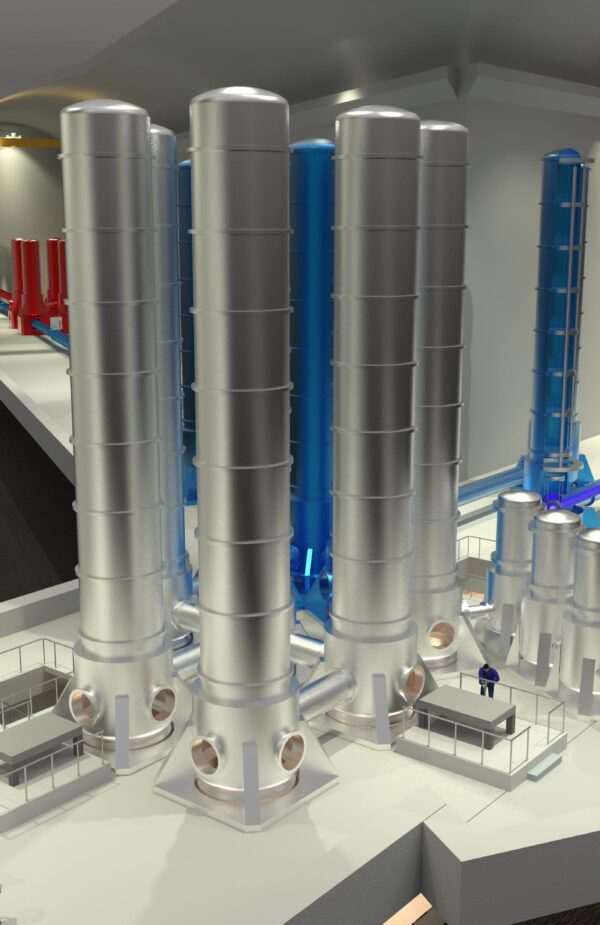
The beam pipe work carried out at CERN is part of the broader collaboration between CERN and the Einstein Telescope Organisation (ETO), set out in an agreement with ETO’s lead institutes and implemented through addenda covering specific activities. Under this agreement, CERN coordinates the development of the ET vacuum beam pipe, drawing on contributions from participating institutes and other partner laboratories.
The collaboration continues through 2027, culminating in the transfer of equipment, procedures and know-how to the ETO Engineering Department, which will ultimately be responsible for the construction of the vacuum beam pipes. In addition, CERN exchanges experience with Cosmic Explorer, the US-led third-generation gravitational-wave observatory, sharing developments in vacuum technology between the two projects.
We asked Carlo Scarcia, Paolo Chiggiato, and Anité Pérez, who are closely involved in the ET beam pipe activities at CERN, to explain why this system matters and what is being learned from the ongoing work.
Why is the beam pipe one of the key technologies of the Einstein Telescope? What exactly is being built and tested at CERN in the pilot sector, and what stage has the work reached now?
Carlo: The beam tube is a key technology because it defines the environment in which the laser beam travels over kilometres. The Einstein Telescope will measure extremely small changes in the optical path length, of the order of 10-19 m or even less. Any interaction of the laser with residual gas molecules, thermal gradients, acoustic noise, vibrations, dust, or contamination can introduce noise or operational risk.
The challenge is not simply to make vacuum. We already know how to make ultra-high vacuum (UHV) in large scientific facilities such as LIGO, Virgo or the LHC. The real challenge for ET is to build such a system on an unprecedented scale , using 1 meter diameter beam pipes, with the required cleanliness, stability and reliability, but at a cost that is realistic for the project. For ET, the vacuum system is expected to be one of the largest cost items after civil engineering, so the beam pipe is both a scientific and an industrial challenge.
Anité: At CERN, we are building and testing a full-scale pilot sector of the ET beam pipe vacuum system. It is not a small laboratory model: it uses real-size beam pipes, around 1 meter in diameter, with a total beamline length of about 36 meters. The aim is to reproduce the main technical constraints of the final ET beam pipe: material choice, welding, cleanliness, supports, alignment, vacuum pumping, leak detection, bakeout, instrumentation and integration in a realistic environment.
Paolo: The pilot sector is designed as a test bench for comparing different technical solutions. In particular, it allows us to test ferritic stainless steel pipes, welding procedures, assembly methods, dust-control strategies, pumping layouts, thermal insulation and the integration of baffles and vacuum ancillaries. The target vacuum performance is in the 10-10 mbar range, with strong cleanliness requirements (around ISO 6 level) comparable to cleanroom conditions, where the number of dust particles in the air is strictly limited.


What makes the scale of the Einstein Telescope vacuum system not just a large engineering task, but a completely new kind of challenge?
Carlo: The novelty lies in the combination of scale and requirements. A few metres of UHV beam pipe can be made with almost perfect accuracy. A few kilometres can be built at a reasonable cost with highly controlled procedures. But ET needs around 120 km of large-diameter UHV beam pipe installed underground with strict cleanliness, low outgassing, reliable welds, and affordable industrial production. This changes the problem completely. Every choice that is acceptable for a short system becomes critical when applied across the entire system : material cost, weld time, leak rate, cleaning procedure, insulation material, transport, installation sequence and operation strategy.
The pilot sector is much shorter than the final ET beam pipe, but it is meant to answer big questions. What are you trying to learn from it that could not have been learned from drawings, simulations, or small laboratory tests alone?
Paolo: Simulations and 3D models are essential, but they cannot fully capture the practical challenges of building a real system. The pilot sector shows what happens when all constraints are present simultaneously: large, thin-walled tubes, real welding setups and supports, alignment challenges, and operators working in constrained spaces while maintaining dust-controlled conditions.
For example, a support may be mechanically correct on paper, but may turn out to be difficult to align during installation. A cleaning procedure may work well in a small test, but become much more complex when applied to metre-scale pipes. The pilot sector is where these issues appear before ET construction starts.
What are the main requirements? (vacuum, cleanliness, stability, manufacturability, cost, and installation) Which ones are proving the most demanding?
Carlo: In my view, the most demanding part is not one single requirement, but their combination. We need a pipe that is affordable enough for large-scale production, clean enough for an optical interferometer, compatible with UHV, joined with clean, simple solutions that are stable over decades, and installable underground at industrial speed.
Optimising one requirement alone is easy, but satisfying all of them together is the real challenge.
A beam pipe may look simple from the outside — just a long metal tube. What makes the choice of material and welding technique so critical for the Einstein Telescope?
Anité: The material controls many key parameters: cost, gas load at different stages of vacuum commissioning, corrosion behaviour, mechanical stability, weldability, and many others. Welding is equally critical because every weld is a potential source of leaks, contamination, deformation and additional outgassing. Across such an extensive system, even a small problem repeated thousands of times becomes a major risk.
In particular, for ferritic stainless steels, if the grade is not chosen accurately, one might risk the formation during welding of unwanted grain sizes that compromise the mechanical resistance of the joint. That’s why for ET, we propose stabilised grades that are more permissive in terms of heat deposition and offer a wider space for the optimisation of the welding parameters.


Why is CERN a place to carry out this work for ET?
Carlo: CERN is valuable because it has decades of experience with large vacuum systems and their diversity, underground infrastructure, industrial procurement, quality control, and long-term operation. CERN also sits at the interface between research and industry: it can translate scientific requirements into technical specifications that companies can actually manufacture.
Who else is involved in the beam pipe activities, and what does each partner bring to the project?
Paolo: The work is carried out in collaboration with several partners across Europe. For example, an open collaboration with LAPP, the Annecy Particle Physics Laboratory in France, is underway on the design of the beam pipe supporting system, with Alexandre Lacroix handling the associated simulations to ensure effective study of ground vibrations transmitted to the beam pipe. Another collaboration involves the Materials Engineering department of Ghent University, which performed qualitative corrosion tests on ferritic stainless steels and welded samples. Another example of synegic collaboration is that we entertain with IFAE, where Mario Martinez and his team design the optical baffles that are integrated in the beam tubes for the control of the scattering light and which prototypes are going to be installed in the ET pilot sector. More recently, the SVAPET (Swiss Vacuum & Precision – ET) consortium, funded by the Swiss Confederation and led by the Paul Scherrer Institute (PSI), is working with industrial partners to develop new large isolation gate valves, expansion bellows, and joining methods for the beam pipes. In parallel, the knowledge and expertise gained through these activities are shared with the MACBETH and Beampipes4ET projects, which focus on the industrialisation of corrugated beam tube production and the optimisation of manufacturing processes, respectively. More broadly, the collaborations extend beyond joint studies and technological developments to include in-kind personnel contributions. In particular, through collaborations with UAntwerp and Nikhef, two fellows are currently working on site, contributing to the construction of the pilot sector while receiving hands-on training in the vacuum laboratories.
For industry, where do you see the most interesting opportunities in the ET beam pipe work?
Anité: The opportunities are broad: pipe manufacturing, forming, welding, automated inspection, cleaning, vacuum components, supports, metrology, thermal insulation, logistics and installation tooling. For the industry, the most interesting point is that the Einstein Telescope is not asking for a one-off prototype. It is asking for a reproducible industrial process for one of the largest UHV systems ever built. Companies that help bridge the gap between the project’s large scale and industrialisation will play a crucial role.
What are the future steps?
Carlo:The next steps are to complete the pilot sector validation, compare some technical options with a second 36-metre beamline, quantify the performance and cost impacts, and feed the results into a new technical design report. This includes confirming the material choice, welding strategy, cleaning procedure, pumping layout, bakeout approach, integration constraints and industrial production route. After that, the work must transition from pilot-scale validation to procurement specifications and pre-series industrial production.

What do you personally find most exciting about this project — and is there a moment or story from the CERN work that captures why it matters?
Carlo: What I find most exciting is the constant stream of challenges this project presents, even in the most minute details. Everything has to be thought, designed, and commissioned with the precision typical of such an ambitious experiment, but with the economy and scale typical of the mass-production industry. If I had to capture a moment in time when our work was unique, I would certainly pick the very first time I measured the vacuum performance of ferritic stainless steels: it took me a few weeks to make the measurements, but an entire year to figure out why they were so good.
Photos: P. Chiggiato
Cover photo: A. Freise, P. Chiggiato