Since the first detection of gravitational waves a decade ago, gravitational-wave searches have become a valuable addition to the cosmological probes we use to study and unveil the mysteries of the universe. The LIGO/Virgo/KAGRA collaborations have already detected hundreds of gravitational wave events produced by mergers of compact objects, giving us a better understanding of the population properties of black holes or neutron stars. But a whole different class of signals is still out there, waiting to be detected. Those signals are produced by processes in the early Universe. Due to the weakness of gravitational interactions they travel freely through the cosmos, carrying information about physics that we cannot get in any other way.
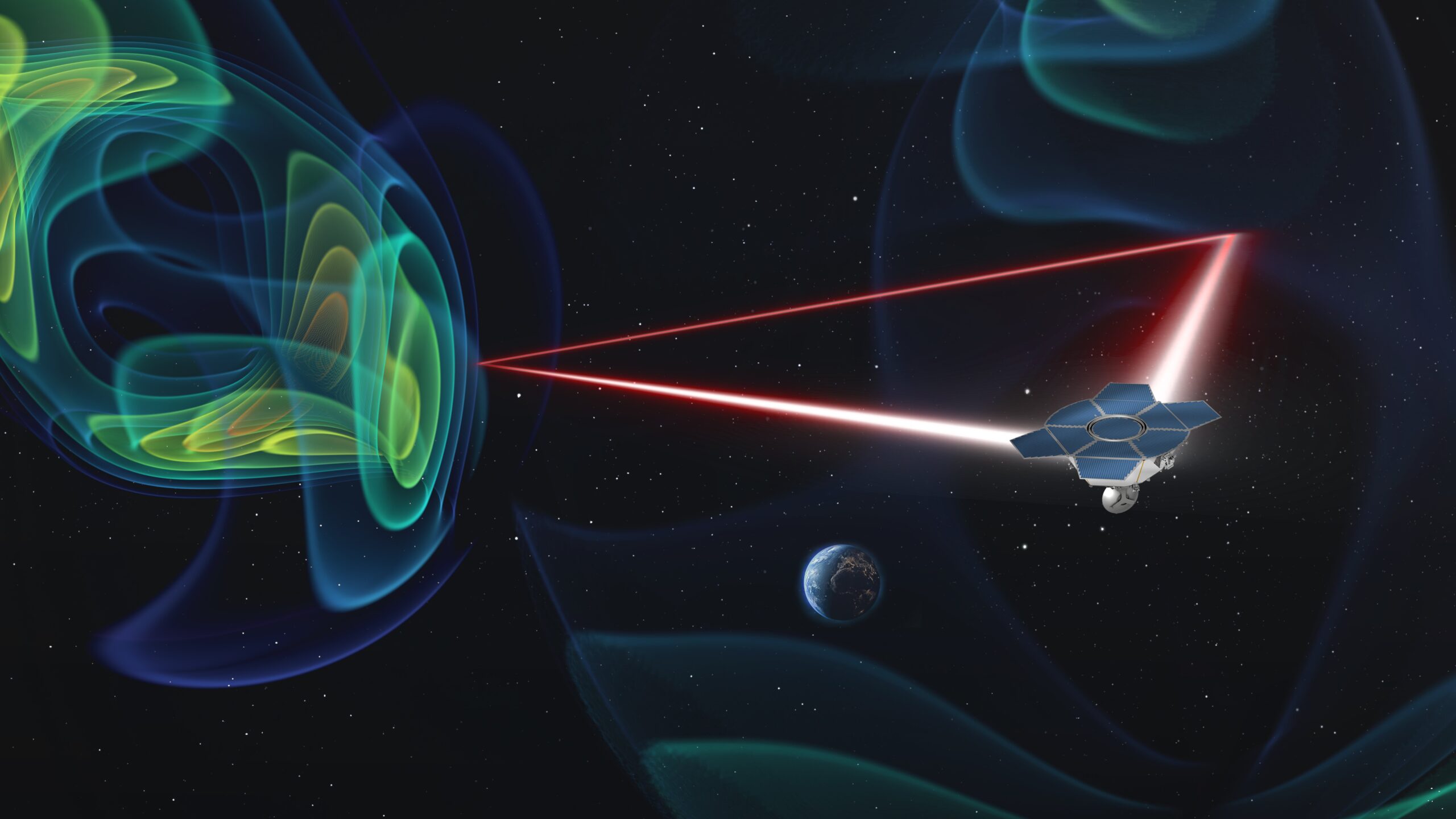
These cosmological gravitational wave signals are among the main targets that future detectors like the Laser Interferometer Space Antenna (LISA) and the Einstein Telescope (ET) will try to observe. These two detectors probe different frequency bands. LISA in space will cover the millihertz, while ET down here on Earth will cover the range from unity to thousands of hertz.
Unfortunately, we do not know in advance at which frequency any specific signal will appear. This depends on the process that generated it which can span many orders of magnitude in energy. Roughly speaking, the frequency of a signal today is tied to the energy scale at which it was produced, which is unknown. This means that different frequency bands correspond to different epochs or periods of time. For example, gravitational waves associated with asteroid-mass primordial black holes would peak at LISA’s millihertz band, while the ones related to heavier black holes would produce a signal at smaller frequencies. A signal can appear strong in one band and only a bit in another, or be at its strongest somewhere in between where both experiments cannot detect it. In fact, the signals are not expected to completely appear in one detector’s band or in another. They could show up only partially, with the main contribution being outside of the detector range. So, if two (or more) gravitational wave detectors look at similar frequencies, their combined efforts could be crucial.
This is the main reason for our Synergy project, the first official project between two gravitational wave communities (the Einstein Telescope and LISA). Combining what different detectors see across the bands should make it easier to work out the shape of the background, separate the cosmological part (coming from the early-Universe) from the astrophysical one (produced more recently by astrophysical sources), and potentially tell apart models that would look basically the same through a single instrument.
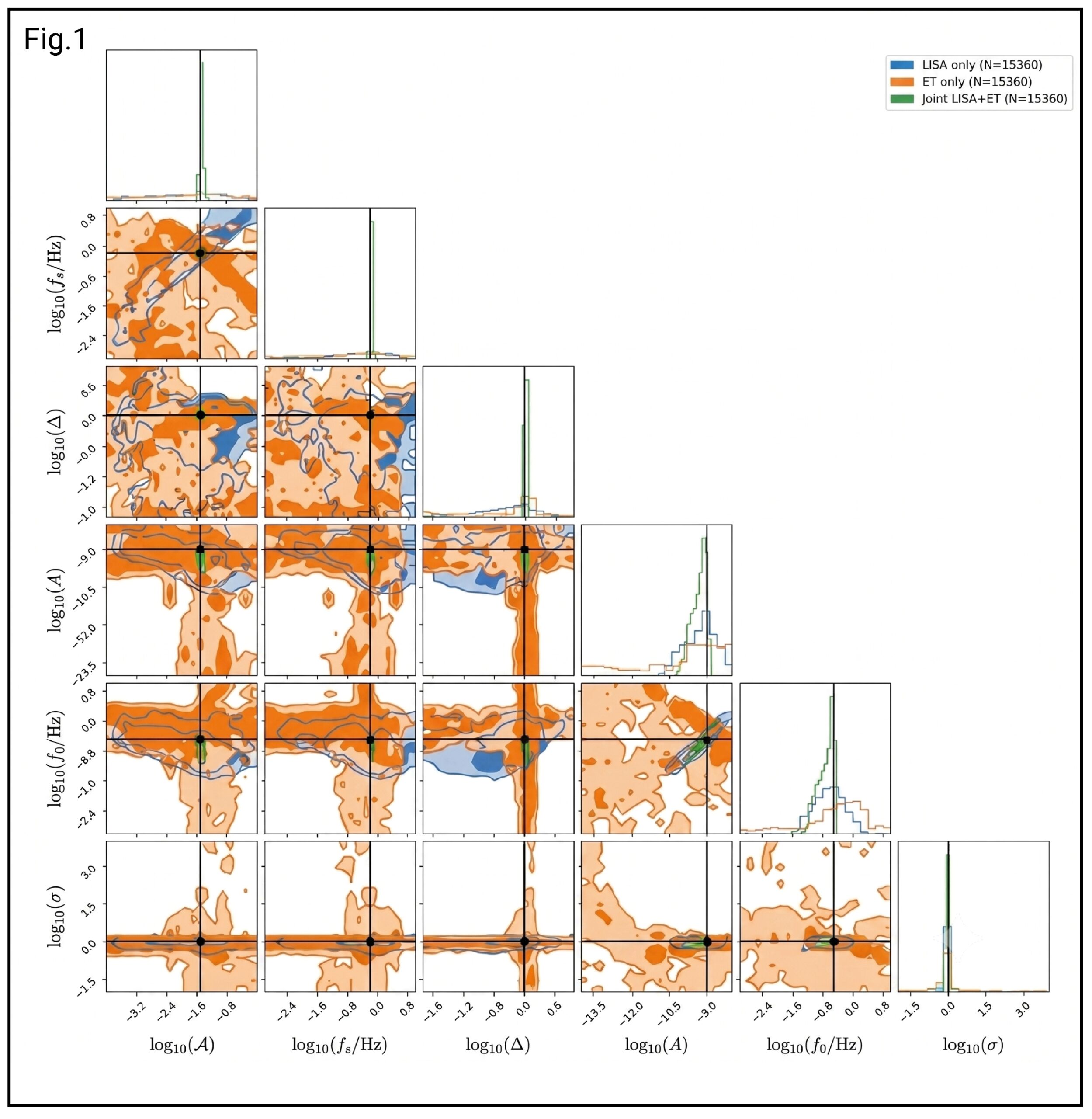
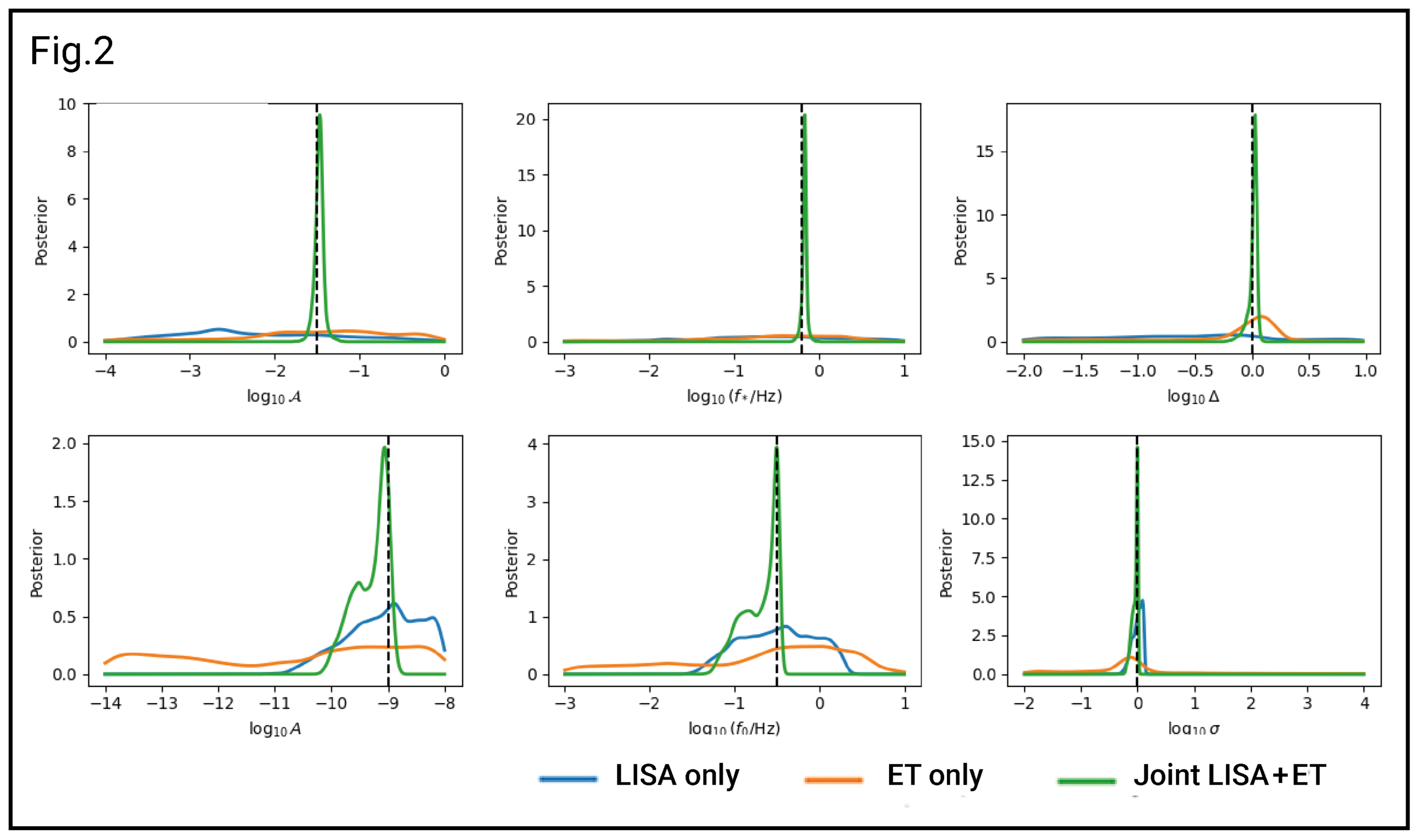
Preliminary tests (Fig.1) already showed the extreme gain in characterising GW signals when LISA and ET are considered together. Fig.2 shows updated estimates about specific GW source parameters, obtained by combining prior knowledge with the data from both detectors. These are so-called joint posteriors (green lines) and are compared here to posteriors from the single detectors (LISA only = blue lines, ET only = orange lines).
Images: LISA-ET Synergy Project
There is also a practical side to this project. LISA and ET already work on overlapping questions, but the analysis codes and conventions have mostly grown up separately. This makes sharing work across the two communities harder than it should be. One of the goals of the project is to overcome this and build something that both sides can use.
The plan is to create a code that the collaborations can use together to perform a joint analysis between gravitational wave detectors, and developed to make it easy to add other detectors to the network, including future ones such as Cosmic Explorer in the US.
The ET-LISA Synergy Project started in January 2026, and has grown into an ambitious global undertaking. The project is coordinated by Antonio J. Iovino (NYU, Abu Dhabi) and Gabriele Perna (KBFI, Tallinn). More than forty people are involved so far from both the ET Collaboration and the LISA Consortium, spanning Europe, the United States, the United Kingdom and Asia and bringing a mix of expertise to both the theory and coding elements of the project. Besides the actual coding work, the other main deliverables that will be produced are two scientific papers: one focuses on different cosmological gravitational wave signals and how they look across the bands, and the other introduces the code so the scientific community can easily use it.
The project coordinators are very enthusiastic about the prospect: “Preliminary tests already showed the extreme gain in characterising gravitational wave signals when more detectors are considered together and we’re excited to explore the wider cosmological implications!”