
Einstein Telescope Science
Our knowledge of the Universe has grown incredibly in the last century, but with new knowledge come new problems, puzzles and extraordinary challenges for scientists. This is where the Einstein Telescope comes in. We now know much more about the origin, evolution and structure of our cosmos than when Einstein formulated his revolutionary theory of relativity, and thanks to the next generation gravitational wave detector we’ll learn even more.
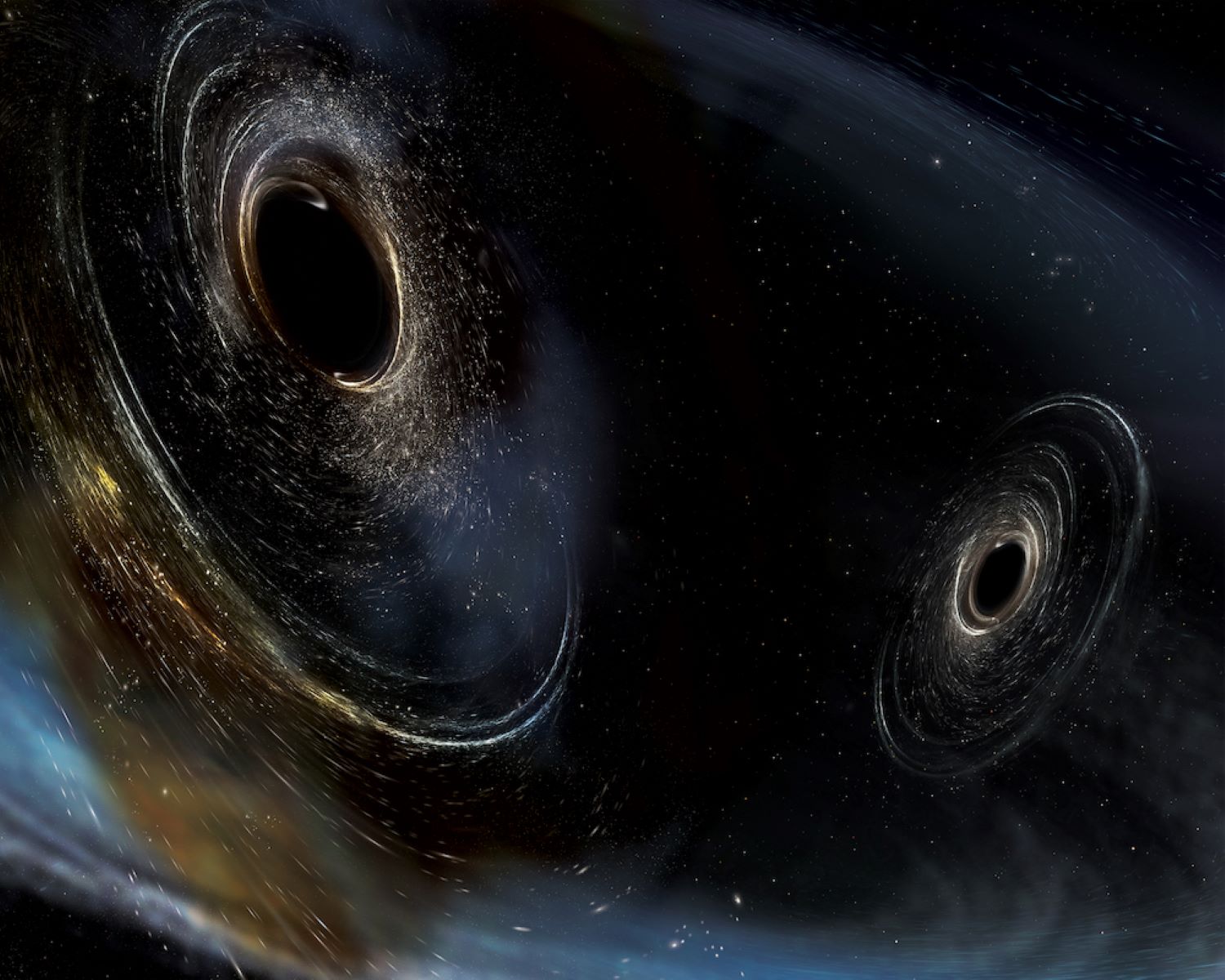 Artist's rendition of two merging black holes merging while spinning in a non-aligned fashion, meaning that they have different orientations relative to the overall orbital motion of the pair. Credits: LIGO/Caltech/MIT/Sonoma State (Aurore Simonnet)
The first detection of gravitational waves in 2015 ushered in a new way of exploring the Universe, allowing us to listen to the faint gravitational echo of remote and powerful cosmic quakes. In the last decade, thanks to the gravitational antennas LIGO, Virgo and KAGRA, our way of observing the cosmos has undergone a real revolution, and things are about to change once again.
The Einstein Telescope, with a sensitivity higher than any instrument before, will give us in-depth knowledge about some of the most extreme astrophysical phenomena: black hole populations, the nature of neutron stars and what happens when they merge, and hopefully also core-collapse supernovae. With the detection of more and more distant gravitational wave signals, the Einstein Telescope will help us answer some of the still open questions of contemporary cosmology and astronomy, such as: what is the mysterious dark energy accelerating the expansion of the Universe? Were black holes formed in the earliest epochs of the cosmos?
The Einstein Telescope will also play a key role in the success of multi-messenger astronomy with gravitational waves, a new way of observing our cosmos that aims to study cosmic phenomena through the parallel observations of messengers or signals of different natures: from gravitational waves to electromagnetic waves, cosmic rays and neutrinos…. This new era was born in 2017, when a gravitational wave signal detected by LIGO and Virgo was also observed across the electromagnetic spectrum by 70 observatories on 7 continents and in space.
Gravitational waves, which move at the speed of light through the Universe without being blocked by cosmic matter, could serve as a probe to reveal the hidden and ‘dark’ side of the Universe. For this reason the Einstein Telescope will provide us with rich new information about the behaviour, structure and history of the Universe, shedding light also on its earliest evolution and on the most intriguing puzzles of fundamental physics today.
For a detailed overview of the scientific potential of the Einstein Telescope, see the ET Collaboration’s Science Blue Book: The Science of the Einstein Telescope.